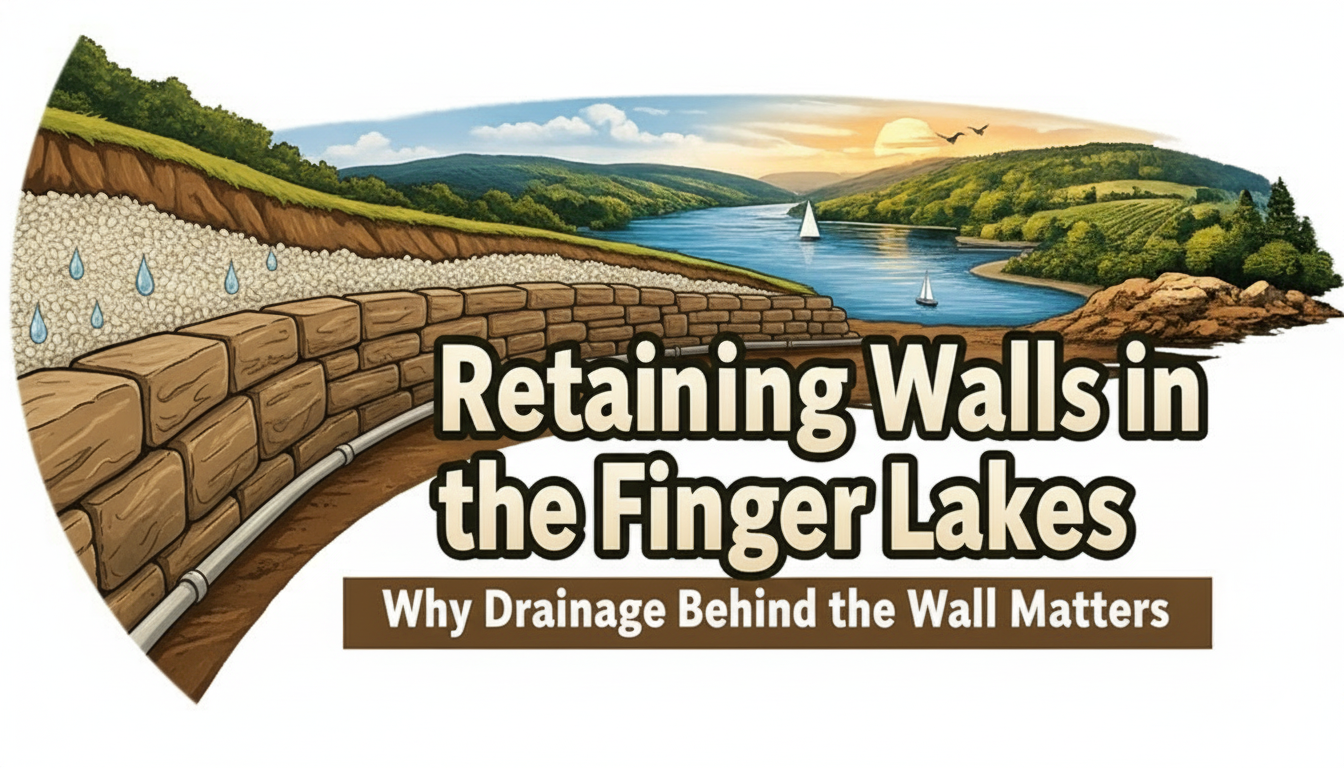
Retaining walls look like structural features. In practice, they behave like drainage systems with a structural face. Most failures in retaining walls don’t come from weak materials or poor stacking. They come from unmanaged water pressure building up behind the wall.
In the Finger Lakes region, this becomes more pronounced. The combination of clay-heavy soils, seasonal freeze-thaw cycles, and varying groundwater conditions creates constant movement and moisture buildup. A wall that ignores drainage will eventually shift, bow, or fail.
This is why drainage design carries more weight than the wall itself.
Understanding What a Retaining Wall Actually Does
A retaining wall holds back soil at different elevations. That sounds simple, but the soil behind the wall is not static. It expands, contracts, absorbs water, and applies pressure.
There are two types of pressure acting on a wall:
- Soil pressure from the weight of the earth
- Hydrostatic pressure from trapped water
Soil pressure remains relatively predictable. Hydrostatic pressure does not. Water builds force quickly, especially when it has nowhere to go.
A properly built wall manages both. A poorly drained wall only handles soil, and that’s where problems begin.
Why Drainage Matters More Than the Wall Structure
Water is the most disruptive force behind a retaining wall. When water accumulates:
- It increases lateral pressure
- It weakens soil stability
- It causes freeze expansion in colder months
Even a well-built wall with quality materials will fail if water is trapped behind it.
Drainage reduces that pressure before it becomes a structural issue. It allows water to move away from the wall instead of building force against it.
This is not an optional feature. It is the functional core of the system.
The Finger Lakes Factor
The Finger Lakes region introduces specific conditions that make drainage even more critical.
1. Clay and Dense Soils
Many areas contain clay-rich soil that retains water. Instead of draining naturally, water lingers and builds pressure.
2. Freeze-Thaw Cycles
Water trapped behind a wall freezes in winter. When it expands, it pushes against the structure. Repeated cycles lead to cracking and shifting.
3. Sloped Terrain
Properties often include elevation changes. This directs water flow toward retaining walls, increasing the load on the system.
4. Seasonal Rainfall
Heavy rainfall and snowmelt introduce large volumes of water into the soil over short periods.
These factors make drainage design non-negotiable in this region.
What Happens When Drainage Is Ignored
Retaining wall failure follows a predictable pattern when drainage is missing or inadequate.
Early Signs
- Water pooling near the base
- Damp or stained wall surfaces
- Minor soil erosion
Mid-Stage Issues
- Wall bulging outward
- Cracks forming in joints or blocks
- Soil shifting behind the wall
Full Failure
- Wall leaning or collapsing
- Soil sliding forward
- Structural separation
These issues rarely come from the wall material itself. They come from pressure building behind it over time.
Key Drainage Components Behind a Retaining Wall
A functional retaining wall includes multiple drainage elements working together.
1. Gravel Backfill
Instead of compacting soil directly behind the wall, a layer of clean gravel is used.
Purpose:
- Creates space for water movement
- Prevents water from being trapped
Gravel acts as a drainage medium rather than a barrier.
2. Perforated Drain Pipe
A perforated pipe runs along the base of the wall.
Purpose:
- Collects water from the backfill
- Directs it away from the wall
This pipe must slope correctly to ensure consistent flow.
3. Filter Fabric
A geotextile fabric separates soil from gravel.
Purpose:
- Prevents soil from clogging the drainage system
- Maintains long-term flow capacity
Without it, fine soil particles will eventually block drainage paths.
4. Weep Holes or Outlets
Water needs a visible exit point.
Purpose:
- Releases collected water from behind the wall
- Reduces pressure buildup
These outlets should remain clear and functional at all times.
5. Proper Grading
Surface grading directs water away from the wall.
Purpose:
- Prevents excess water from entering the system
- Reduces load on drainage components
Drainage starts above the wall, not just behind it.
Drainage vs Wall Material: What Actually Matters More
There’s often a focus on choosing between:
- Concrete blocks
- Natural stone
- Timber
Material choice affects appearance and lifespan, but it does not control water behavior.
Here’s how they compare in context:
| Factor | Wall Material | Drainage System |
| Structural strength | Important | Secondary role |
| Water management | Minimal | Primary function |
| Failure prevention | Limited | Critical |
| Longevity | Dependent on drainage | Determines lifespan |
A high-end wall with poor drainage will fail. A basic wall with proper drainage will perform reliably.
Common Drainage Mistakes
Even when drainage is included, execution errors can reduce effectiveness.
1. Using the Wrong Backfill
Soil or mixed fill instead of clean gravel blocks water movement.
2. Improper Pipe Installation
Flat or incorrectly sloped pipes prevent water from exiting.
3. Missing Filter Fabric
Leads to clogging over time.
4. No Exit Path
Water collects in the system with nowhere to go.
5. Ignoring Surface Water
Downspouts or slopes directing water toward the wall increase pressure.
Each of these reduces the system’s ability to manage water effectively.
When You Need Professional Installation
Retaining walls may look straightforward, but drainage design requires planning.
Professional installation becomes important when:
- The wall exceeds a few feet in height
- The property has significant slope
- Soil conditions are variable
- Water flow patterns are unclear
A contractor familiar with the Finger Lakes region will account for local soil behavior and seasonal conditions.
Long-Term Maintenance of Drainage Systems
Drainage systems require minimal but consistent maintenance.
What to check periodically:
- Clear weep holes and outlets
- Ensure water flows away from the wall
- Watch for pooling or erosion
- Inspect for early signs of movement
Small issues can be corrected early before they affect the structure.
Practical Example
Consider two retaining walls built on similar slopes:
Wall A:
- High-quality stone
- No drainage system
Wall B:
- Standard block construction
- Full drainage system installed
After a few seasons:
- Wall A shows bulging and water damage
- Wall B remains stable
The difference comes from water management, not material quality.
Why This Matters for Property Owners
A retaining wall is often part of a larger landscape plan. It supports:
- Driveways
- Patios
- Foundations
- Yard grading
Failure affects more than the wall itself. It can impact surrounding structures and require full reconstruction.
Building it correctly the first time avoids repeated costs and disruptions.
Final Thoughts
In the Finger Lakes, retaining walls operate under constant environmental pressure. Soil movement, moisture retention, and seasonal changes all contribute to long-term stress.
The wall provides structure. The drainage system controls the conditions behind it.
When drainage is designed correctly, the wall performs as expected. When it’s ignored, failure becomes a matter of time.
Planning a Retaining Wall Project?
If you’re building or repairing a retaining wall in the Finger Lakes, drainage should be part of the design from the start.
Work with a team that understands soil behavior, grading, and long-term water management.
Explore retaining wall and sitework solutions here. A well-built wall starts behind the wall, where water is managed before it becomes a problem.